On the Spot with UNH Graduate School Assistant Dean Dovev Levine

The UNH Graduate School has over 100 programs on campus, according to Assistant Dean Dovev Levine. In those programs, he said that there are about “150 to maybe 175 students” doing an Accelerated Master’s Program during their senior undergraduate year.

Levine hosted a Graduate School information session where he said over 50 students attended, leaving no seat empty on Thursday afternoon, Nov. 3 in the Memorial Union Building (MUB). Levine said that this session was to answer general questions about the grad school and encourage students to look into the Accelerated Master’s Program.

Later, on Friday, Nov. 18, Levine was interviewed about additional questions concerning the grad school and its accelerated program, and also his favorite parts of the job.

Serving as assistant dean since January 2016, Levine describes himself as a “Jack-of-all-trades” for the grad school. According to the university’s website, his responsibilities include “coordinating the admissions process, marketing for the Graduate School, recruitment, dealing with petitions and a variety of student-related items.”

“I handle admissions,” Levine said. “I also handle a lot of the student based issues as well. So I do things like working with students on petitions for exceptions to policy in their grad program. I work on things like helping students to get their thesis ready as far as the formatting goes. I work with programs to help set the policy for their grad programs and over all grad school process and all the points in between. So basically anything to do with grad school education, I’m usually fairly involved with.”

Levine, who has been with the UNH Graduate School since 2003, said he did his undergrad at UNH in ancient history and went on to do his PhD in natural resources and earth sciences. As someone who continued on to graduate school at the same school where he got his undergraduate degree, Levine said that he thinks participating in an accelerated master’s program is an excellent option for students who know what career direction they want to take.

“In fact, of all of our grad students over time, 33 percent got their bachelors at UNH. So that’s actually the biggest source for our own grad students. That speaks to the fact that a lot of students make that choice. I think it’s a good choice to stay on for their masters or PhD,” he said.

The Graduate School’s accelerated master’s program offers several advantages to senior undergraduate students including eligibility to take up to 12 graduate level credits toward a master’s degree prior to receiving a bachelor’s degree during senior year, there is no additional tuition cost and courses may be taken for graduate-only or dual credit, according to the website. Restrictions include that courses must be at 800/900 level, must be passed with at least a B- and students must maintain a GPA of 3.2 or better.

“It’s a considerable amount of our over all grad population that actually comes to our grad program by the way of the accelerated master’s program. So it’s great way to save time, obviously because if you do three classes and get those done, then that means you’re getting –most masters programs are about 10 classes– so you’re getting almost a third of them done while you’re still a senior,” Levine said.

Levine said that if students chose to go elsewhere for graduate school, accelerated master’s program credits may or may not transfer, depending on the school and its higher education program. He said that it is important to also note that not every master’s program offers the accelerated option, with the UNH Graduate School having about 20 master’s programs that do allow for it.

Applying is also easy for students. Just go to the UNH Graduate School website and find the apply button. “Typically it’s a couple weeks once the application is complete and the program receives it,” Levine said. “It’s not very long.”

“The thing to keep in mind about grad school is that it’s always important to know what career you want to get into,” he said, following by encouraging students to participate in real world experience within a profession, whether it be by internship or job shadows, he said to simply pursue things that will “compliment [students’] classroom and research opportunities.”

Levine said that he absolutely thinks that more UNH senior undergraduates should be taking advantage of the accelerated master’s program.

“We have a host of really highly ranked programs and research centers, and the faculty are really fantastic. There are a lot of professors here who are doing some amazing stuff and I think a lot of students would be really well advised to check out these opportunities and see if they want to do some more in this area,” he said. “And the grad school is here to help.”

Sharing study abroad success stories

As part of International Education Week at UNH, students, alums and faculty gathered in the Memorial Union Building on Tuesday, Nov. 14 from 12:40-2 p.m. to talk about study abroad opportunities available to both undergraduate and graduate UNH students.

Here is the link to the Storify article I created after live-tweeting the event.

Memorial Union Building study spots

At the heart of the UNH campus, the Memorial Union Building (MUB) encompasses many of students’ favorite study spots on campus. On a quiet Sunday afternoon students can be found hitting the books throughout the MUB, though the building is just as popular a study spot during regular week days, it’s never quite so calm.

Screen Shot 2016-11-13 at 4.22.53 PM.png
A hidden gem of the MUB’s plethora of study spots is the first floor Commuter Lounge in room 112.

Only two people were occupying the Commuter Lounge on Sunday, Nov. 13 at 4 p.m. One of them was senior accounting and management major Lieu Nguyen.

Screen Shot 2016-11-13 at 4.23.57 PM.png
Nguyen (left) studying on her laptop. “It’s a quiet little spot that most students don’t know about,” she said on why she likes to study in the Commuter Lounge. “Most students go to the third floor [of the MUB].”
On the second floor, freshman international business major Enoska Ventura was studying for nutrition (NUTR 400) at Union Court. 

Screen Shot 2016-11-13 at 4.27.02 PM.png
Ventura (left) said that though she comes to the MUB often, her favorite place to study is the lounge of her dorm, Hitchcock Hall. “I like studying with other people around, but usually I don’t like noise,” she said. “So, I just come with headphones and it drowns out people sounds so it’s easier to study.”
Screen Shot 2016-11-13 at 4.28.54 PM.png
Union Court is uncharacteristically spacious on a Sunday afternoon.

Freshman biomedical science major Lauren Harper was studying chemistry in the Grafton Living Room, tucked away at the far end of Union Court in room 231.

Screen Shot 2016-11-13 at 4.25.26 PM.png
Pictured here, Harper said that she likes studying in the Grafton Living Room because it’s typically quiet and has comfortable couches. “Sometimes there’s a few people, but it’s never over crowded and it’s never loud,” she said of her chosen Sunday study spot.

One more level up, junior German and international affairs major Dylan Upton had just finished a study session on the third floor.

Screen Shot 2016-11-13 at 4.37.32 PM.png
Pictured here, Upton said he usually comes to the MUB’s third floor couches overlooking Union Court during his down time between classes. “It’s a warm, cozy environment. It’s inviting,” he said.

Upton said that he often meets with friends to study in this space. “It makes studying easier. It’s not super quiet, but it’s not super loud. Like some people don’t like studying in the library because it’s too quiet, it distracts them. Or some people don’t want to study in their dorms because it’s too loud with all the other students hanging around,” he said.

Screen Shot 2016-11-13 at 4.35.34 PM.png
Upton (second to left) said that he often meets with friends to study in this space. “It makes studying easier. It’s not super quiet, but it’s not super loud,” he said. “Some people don’t like studying in the library because it’s too quiet, it distracts them. Or some people don’t want to study in their dorms because it’s too loud with all the other students hanging around.”

Also studying on the third floor  was senior occupational therapy major Paige Brousseau in the Rockingham Lounge, aka “the fireplace room.” Sadly, there was no fire blazing in the lounge on Sunday.

Screen Shot 2016-11-13 at 4.30.25 PM.png
Brousseau (left) studying for an anatomy class on human movement. She said that the Rockingham Lounge is her favorite study spot on campus, and that she tries to study outside her room at least five times a week.

“I think it remains pretty quiet in here. I think people know that it’s a relaxing, quiet place,” Brousseau said of the lounge. She added that she likes the large windows which make the room bright. “It’s the scenery outside, whereas in the library it can be kind of boxed in,” she said.

Screen Shot 2016-11-13 at 4.32.44 PM.png
Three students deeply involved in their studies in the Rockingham Lounge.

Each student interviewed said that they chose their respective study spots according to personal standards of comfort. While some areas, like the Commuter Lounge, are quiet and only see light traffic, other places like Union Court attract students who prefer to have some degree of busy life going on around them. Whatever their preferences, UNH students take their academics seriously, and most therefore aim to seek out spots where they can attain seriously focus. The MUB at the center of the UNH campus provides all these study spot options above, and even more by offering students access to conference rooms and other meeting areas.


Spring scheduling advice for underclassmen

Three returning UNH students were briefly interviewed on Thursday afternoon, Nov. 10, during which they shared advice for underclassmen spring scheduling.

Sophomore child development studies major Elizabeth Tremblay said that after a hectic first semester her freshman year, she tries to choose schedules that leave her with more free time to get work done. After making her second semester schedule her freshman year, Tremblay said that her grades got better because she had more time to study.

Sophomore human development and family studies major Amber Murray said that waiting to declare her major until her sophomore year set her back, making it so that much of the credits she took during her freshman year did not count toward her degree. Murray said her advice to fellow students would be not to wait to declare a major, and to “not just take classes to take them.”

Junior biology major Todd Glynn said that he has already been planning his spring schedule for the past week. He emphasized the importance of having a back up plan and working working closely with academic advisors.

The biggest takeaways from each students’ advice seem to be making sure you have enough free time for studying, having back up options when planning your course schedule and taking discovery and general education classes as early in your Wildcat career as possible.

Students’ favorite classes

Three UNH students from different class standings were interviewed on Thursday afternoon, Nov. 10 about their favorite classes taken during their time at the university.

Sophomore information technology major Grant Gilman said that his favorite class was a discovery course he took for a historical perspectives requirement. The course was HIST 405: The History of Early America, taught by Cynthia Van Zandt.

Junior business management major Emily Cochran said that her favorite class thus far is one she is currently taking, THDA 438: History of Theatre, taught by David Richman.

Senior sociology and justice studies major David Landry said that his favorite class was a criminology course (SOC 515) that was taught by Katherine Abbott.

All three students, from different graduating classes and with different majors, said that they would recommend these favorite classes to other UNH students. With spring scheduling coming up, some students may need help deciding what to take, and many will look to their peers for advice. HIST 405, THDA 438 and SOC 515 are three class options that are endorsed by fellow Wildcats.

UNH students’ reactions following College Democrats, Republicans debate

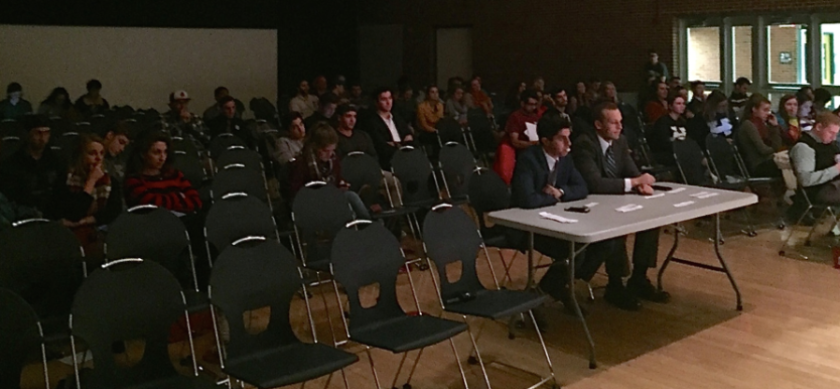
After the debate between the UNH College Democrats and Republicans in the Memorial Union Building’s (MUB) Strafford Room on Wednesday night, student attendees shared some of their post-event reactions. With the upcoming presidential Election Day on Nov. 8, many students said they came to gain exposure to different perspectives, and some even learned something new.

Senior environmental resource economics major was one of those students who was curious to hear an alternative point of view to his own. He said that during the debate he learned that some of his fellow students are not very informed about the Dakota Access Pipeline (DAP) issue, which he said is partially the media’s fault for not covering it more thoroughly. This was in reaction to a question fielded to the UNH Republicans about the DAP, which was met with silence as they clearly did not know what it was.

Screen Shot 2016-11-03 at 2.40.15 PM.png
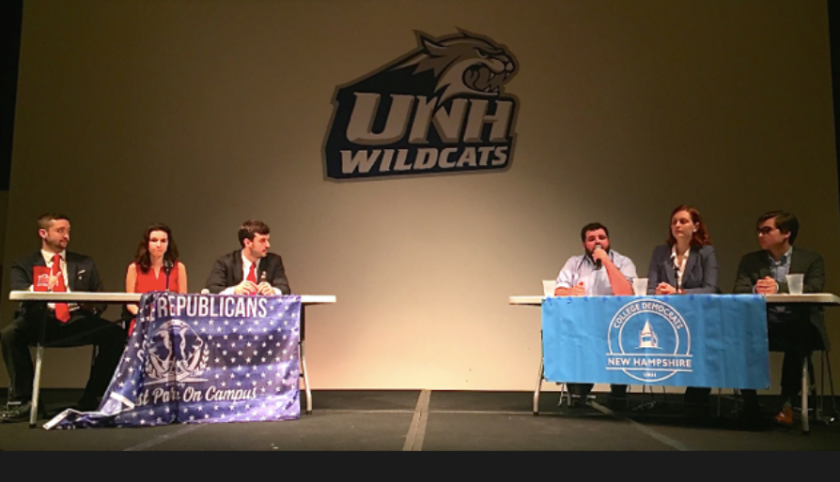
Left to Right: UNH College Republicans Internal Director Nathan Marsolias, member Elizabeth Girard and External Director Scott Myers, UNH College Democrats Vice President Douglas Marino, President Elena Ryan and member Elias Tyrell-Walker.

Junior English teaching major Sarah Slack was likewise concerned with the Republicans’ lack of response to the DAP question.

Slack said she attended Wednesday’s debate because she “was interested in how the political parties on UNH’s campus would have been influence by their candidates.”

Occupational therapy graduate student Molly Ohman said that she came to the debate already knowing she is going to vote for Hillary Clinton and the rest of the Democratic ticket. “I think that’s definitely been solidified in my mind,” she said.

Ohman expressed that her biggest concern is student debt, which is driving her decision to support Democratic candidates.

Moderating the event was senior economics major and UNH Student Body President Jonathan Dean, along with senior political science and justice studies major Ricky Aiello.

Screen Shot 2016-11-03 at 2.41.39 PM.png
Debate moderators Aiello (left) and Dean (right).

Dean said that he thought the event was beneficial to everyone in the audience, and that he learned “Republicans and Democrats can get along sometimes.”


Hosting the debate, which was sponsored by the New York Times, was senior English/journalism major, The New Hampshire Executive Editor and New York Times Collegiate Representative Allison Bellucci.

Screen Shot 2016-11-03 at 2.39.00 PM.png
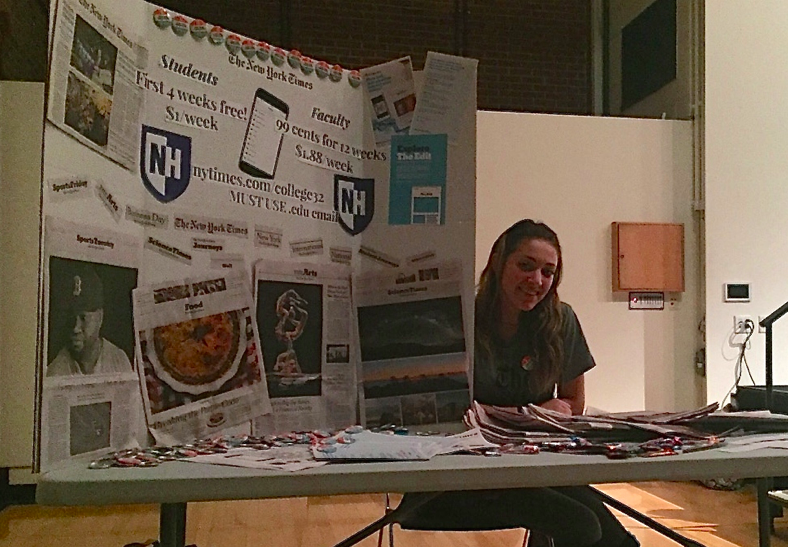
Bellucci representing the New York Times. 

Bellucci agreed with Dean that the event was a success. She said that the biggest thing she learned was the “difference between the College Republican and Democrat views.”

Like Sinclair-Wingate and Slack, Bellucci also said she was surprised by the UNH Republicans’ lack of an answer to the DAP question.

A more critical outlook came from senior English/journalism major and The New Hampshire  Staff Writer Mark Kobzik, who was covering the debate for the Thursday, Nov. 3 issue.

“I was interested to see what the two sides had to say about their respective candidates and the issues to see if they know what’s going on,” Kobzik said. “A lot of them had a lot of good things to say, but in terms of specifics I would have liked to hear more.”

Kobzik said that what he learned from interviewing four of the six people on the stage Wednesday night, was that “there seems to be more social progression among the Republicans,” and “there seems to be more of a sense of compromise.”

Though he said that seeing the UNH Democrats and Republicans sharing common views, he also said that he thought the Democrats “could have pushed back a little bit more,” because there is “a lot of material to sort of debunk and criticize when it comes to the Republican platform.”

Also covering the event for The New Hampshire was Design Editor and sophomore English/journalism major Alycia Wilson, who was live-tweeting. Wilson said that she has “always had an interest in politics.”

Having paid close attention to the student debaters’ responses, Wilson expressed approval of how the UNH Republicans clarified some of their personal opinions and positions, particularly when it came to abortion.

The general consensus of students’ takeaways seemed to be one of hope. Audience members were able to see an example of members of the two different parties engaging in a productive, educated conversation, even coming to agreement on some issues that have been polarizing on the national scale.

UNH College Democrats, Republicans debate for first time

Screen Shot 2016-11-03 at 9.54.36 AM.png
UNH College Republicans on the left, from left to right: Internal Director Nathan Marsolias, member Elizabeth Girard and External Director Scott Myers. On the right, UNH College Democrats, left to right: Vice President Douglas Marino, President Elena Ryan and member Elias Tyrell-Walker.

Though the debate between the UNH College Democrats and Republicans on Wednesday night would probably be more appropriate to cover for a campus politics blog, I went to the event because I personally feel it is important that students learn about the critical issues that whoever is elected on Nov. 8 will have to deal with. Election Day is less than a week away, and local events like this one, where students can hear their peers’ views rather than the voices of mass media, could help steer some students decisions or expand their political views. It was a learning experience for all those in attendance and participating.

Here is a link to my Storify article on the first-ever debate between the UNH College Democrats and Republicans, where I have compiled live-tweets from myself and others at the debate, which ran from 8-9 p.m. and was hosted by New York Times Collegiate Representative Allison Bellucci.

Halloween Film Fiesta

UNH Spanish students gathered on Halloween night to be spooked during the Department of Languages, Literatures and Cultures’ annual Spanish Halloween Party and Film. This year, the department screened Jaume Balagueró’s zombie movie, “REC” (2007), a rated-R Spanish horror film.

Screen Shot 2016-10-31 at 7.42.30 PM.png
Held Monday, Oct. 31 from 6-8:30 p.m. in Murkland Hall room G17, the event had a good turnout, with costumed students filling the classroom. Some came to enjoy the movie and snag free candy, while other attendees were after extra credit being offered by Spanish Professor Jorge Abril Sánchez.
Screen Shot 2016-10-31 at 7.47.06 PM.png
“Feel free to come to the front and get as much as you want. No need to say trick-or-treat or anything,” Abril Sánchez said, inviting attendees to some chocolates and treats before starting the film.
Screen Shot 2016-10-31 at 7.44.13 PM.png
Freshman information technology major Tyler St. Peter (left, in Grim Reaper mask) and his sister Dover High School junior Chris St. Peter (right, in lime green) wait for the movie to start after getting their treats.
Screen Shot 2016-10-31 at 7.50.56 PM.png
“Who watches horror movies?” Abril Sánchez asked the audience. Only two people raised their hands, which explained why there were so many disturbed looking faces during the movie screening.

Screen Shot 2016-10-31 at 7.53.21 PM.png
Students taking notes during the movie, which had English subtitles. Abril Sánchez said that in Spain and other Spanish speaking countries, they don’t really have a lot of horror movies. Of Monday’s screening he said, “It’s a cultural event. It’s good for them [the students] to learn more about Spanish culture.”
Abril Sánchez explained that in Spanish speaking countries, they celebrate Dia de Todos los Santos (All Saints Day) on Nov. 1, which he said is a much “more religious” holiday. “We go to mass, pray for the dead [and] go to the cemeteries to pray for family,” he said. “It has nothing to do with folk lore… In Spain, people get disguised for Carnival, not Halloween…but people are adopting this tradition [Halloween] now.”

Screen Shot 2016-10-31 at 7.49.29 PM.png
The movie, “REC,” is about a reporter and cameraman who record an outbreak of a disease that turns people cannibalistic. Though horrifying, the film was not gruesome enough to ruin attendees’ appetites, as the free candy bowls diminished quickly.

Halloween was on a Monday this year, and thus was not an ideal time for party-goers. The Spanish Halloween Party and Film event was a great way for students to celebrate the holiday without straying from academics. Students got to dress up, enjoy a scary movie and participate in an event that not only increased their knowledge but also expanded upon their cultural awareness.

UNH history professor offering new J-term class inspired by “Game of Thrones”

The UNH January term (J-term) course schedule became available to students on Friday, Oct. 15 and registration opened on Monday, Oct. 24. Having survived midterms, it’s time for students to consider spring scheduling, and many undergraduates may be looking to knock a discovery requirement out of the way.

“If [a professor] is trying to offer a class that students need to take in order to graduate, J-term is a good time to do that,” Registrar’s Office Academic Student Services Assistant Brianna Smith said.

Out of dozens of options, one class that is new to J-term this 2016-17 academic year is Game of Thrones: Power and Politics in Renaissance Europe (HIST 498), taught by history professor Elizabeth Mellyn. The class also fulfills a historical perspectives discovery requirement.

“I plan on using the themes of the series [“Game of Thrones”] as a launching pad for studying similar themes in European history,” Mellyn said, adding that the class will focus on the “turbulent” 16th century.

screen-shot-2016-10-26-at-7-47-24-pm
Part of a flyer for the new online-only J-term history course inspired by HBO’s hit series and George R.R. Martin’s brainchild, “Game of Thrones.”

In addition to reviewing posted lectures establishing historical context and important concepts, students will read texts that address power and sovereignty. Grading for the class will be discussion centered, with students answering short questions, reading peer responses and responding to at least one other person.

This will be Mellyn’s first time teaching an online J-term class. She said she has learned that many students build their schedules by scrolling through UNH’s course search “looking for titles that pique their interest.”

“I realized immediately that I had to start with my stuffy old course titles,” Mellyn said in regard to redesigning her classes to attract students. She said that a student in one of her classes came up with the idea to name the J-term course after “Game of Thrones.”

Having recently started watching the HBO series and reading the Song of Ice and Fire books, Mellyn has admittedly become a “Game of Thrones” fan. “Frankly, I can’t get enough of it,” she said. “Hands down my favorite character is Ned Stark.”

“’Game of Thrones’ seems to be playing a similar role in the imaginations of young and old alike, drawing them back to Europe’s bloody past,” Mellyn said. “George R. R. Martin based his narrative on actual people and events in European history… The themes he introduces are perennial and speak both to the deeper parts of our human nature as well as the big questions all societies grapple with.”

Though “familiarity with the book or cable series will certainly make the class more fun,” it is not necessary to have read or watched “Game of Thrones” in order to succeed, Mellyn said.

The deadline for students to enroll in a J-term class is Dec. 23, with Jan. 3 being the last day to add or drop classes on Webcat. According to the university’s website, no RAC number, instructor or advisor signature is required to sign up for a J-term class.

Design a site like this with WordPress.com
Get started